
Angle sizes and weights: steel, stainless and aluminium equal and unequal angles
Weight per metre and cross-section area of hot-rolled equal steel angles to EN 10056-1 from 20 × 20 × 3 to 120 × 120 × 12, plus stainless 304 and aluminium 6063 angles, the kg/m formula and how angles are designated.
Updated October 18, 2026
An angle is an L-shaped section with two legs at 90°. It is described by its leg lengths and thickness: L50 × 50 × 5 is an equal angle with 50 mm legs and a 5 mm thickness, L75 × 50 × 6 an unequal angle. The tables below give the nominal weight per metre of the angles we supply, so that a drawing, cutting list or freight estimate can be checked quickly.
Standards and grades
- Hot-rolled steel angles are made to EN 10056-1 (dimensions) and EN 10056-2 (tolerances). EN 10056-1 replaced the German DIN 1028 (equal) and DIN 1029 (unequal) standards, so older drawings that call up DIN 1028 refer to the same sizes.
- Steel grades are usually S235JR, S275JR or S355JR to EN 10025-2. See structural steel grades.
- Stainless steel angles follow EN 10056-1 sizes in 1.4301 (304). See 304 vs 316 stainless steel.
- Aluminium angles are extruded to EN 755-2 in EN AW-6063 T6 and have sharp or slightly rounded corners rather than the root radius of a rolled steel angle.
Steel equal angles (EN 10056-1)
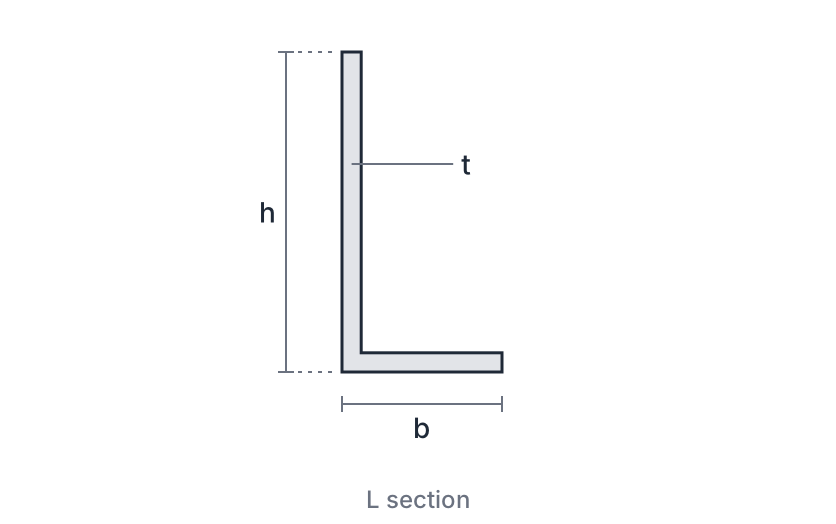
| Size (mm) | Weight (kg/m) | Area (cm²) | Metres per tonne |
|---|---|---|---|
| 20 × 20 × 3 | 0.88 | 1.12 | 1134 |
| 25 × 25 × 3 | 1.12 | 1.42 | 895 |
| 25 × 25 × 4 | 1.46 | 1.85 | 687 |
| 30 × 30 × 3 | 1.36 | 1.74 | 734 |
| 30 × 30 × 4 | 1.78 | 2.27 | 562 |
| 35 × 35 × 4 | 2.09 | 2.67 | 478 |
| 40 × 40 × 4 | 2.42 | 3.08 | 414 |
| 40 × 40 × 5 | 2.97 | 3.79 | 336 |
| 45 × 45 × 5 | 3.38 | 4.30 | 296 |
| 50 × 50 × 5 | 3.77 | 4.80 | 265 |
| 50 × 50 × 6 | 4.47 | 5.69 | 224 |
| 60 × 60 × 6 | 5.42 | 6.91 | 184 |
| 60 × 60 × 8 | 7.09 | 9.03 | 141 |
| 65 × 65 × 7 | 6.83 | 8.70 | 146 |
| 70 × 70 × 7 | 7.38 | 9.40 | 136 |
| 75 × 75 × 8 | 9.00 | 11.47 | 111 |
| 80 × 80 × 8 | 9.63 | 12.27 | 104 |
| 80 × 80 × 10 | 11.86 | 15.11 | 84 |
| 90 × 90 × 9 | 12.18 | 15.52 | 82 |
| 100 × 100 × 10 | 15.04 | 19.15 | 67 |
| 100 × 100 × 12 | 17.83 | 22.71 | 56 |
| 120 × 120 × 10 | 18.20 | 23.18 | 55 |
| 120 × 120 × 12 | 21.62 | 27.54 | 46 |
The steel equal angle page lists all 138 sizes we supply, including light angles from 18 × 18 to 50 × 50 mm in 2 to 3.5 mm thickness and intermediate legs such as 23, 28, 33, 43 and 48 mm. Unequal steel angles are not in our standard list; ask in a quote request if you need them.
Stainless steel angles (304)
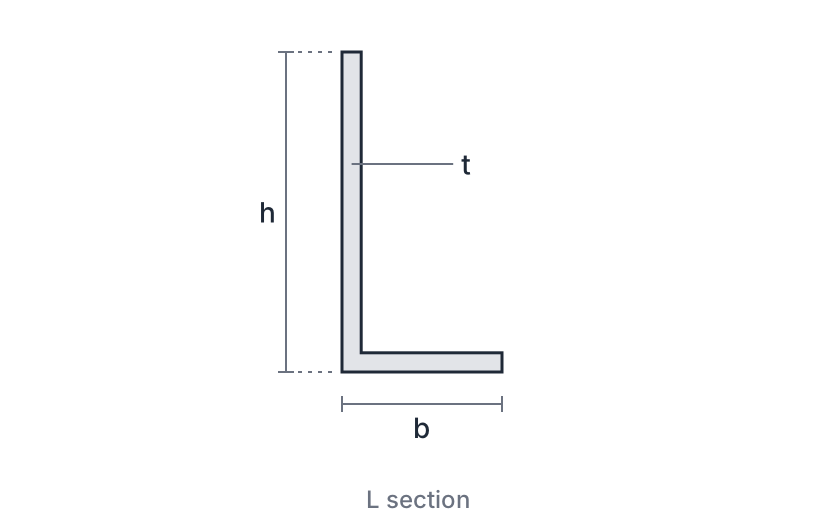
| Size (mm) | Weight (kg/m) |
|---|---|
| 20 × 20 × 3 | 0.88 |
| 25 × 25 × 3 | 1.12 |
| 30 × 30 × 3 | 1.36 |
| 40 × 40 × 4 | 2.41 |
| 50 × 50 × 5 | 3.77 |
| 60 × 60 × 5 | 4.56 |
Aluminium angles (6063 T6)
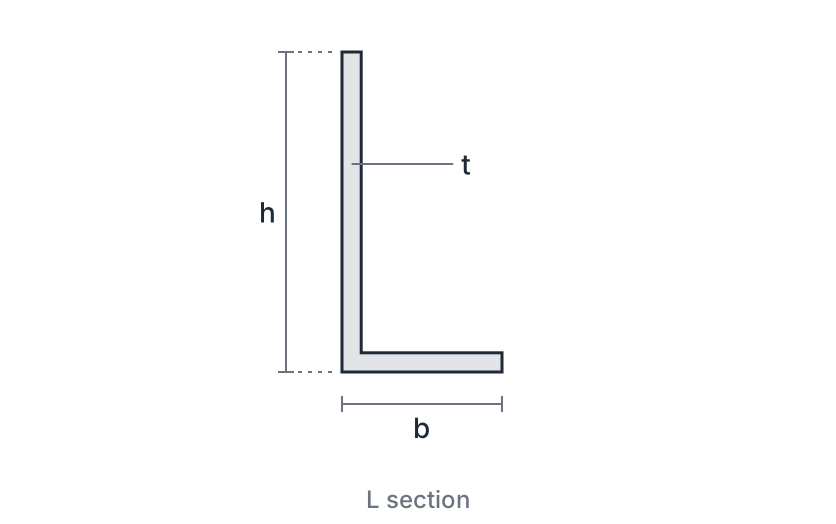
| Size (mm) | Weight (kg/m) |
|---|---|
| 10 × 10 × 1.2 | 0.061 |
| 15 × 15 × 1 | 0.078 |
| 20 × 20 × 1 | 0.105 |
| 20 × 20 × 2 | 0.205 |
| 25 × 25 × 1 | 0.132 |
| 25 × 25 × 2 | 0.259 |
| 30 × 30 × 1.2 | 0.191 |
| 30 × 30 × 2 | 0.313 |
| 30 × 30 × 3 | 0.462 |
| 40 × 40 × 1.2 | 0.255 |
| 40 × 40 × 2 | 0.421 |
| 40 × 40 × 3 | 0.624 |
| 40 × 40 × 4 | 0.821 |
| 40 × 40 × 5 | 1.013 |
| 50 × 50 × 2 | 0.529 |
| 50 × 50 × 3 | 0.786 |
| 50 × 50 × 5 | 1.282 |
| 60 × 60 × 2 | 0.637 |
| 60 × 60 × 3 | 0.948 |
| 60 × 60 × 6 | 1.847 |
| 100 × 100 × 10 | 5.130 |
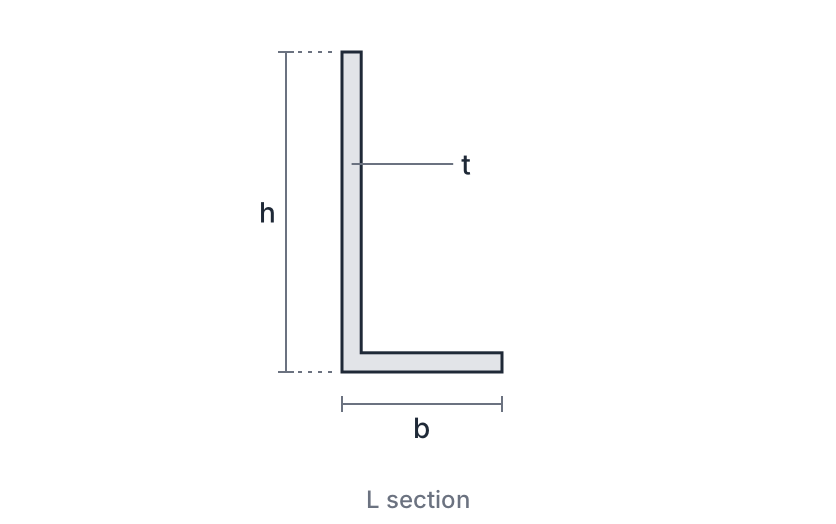
| Size (mm) | Weight (kg/m) |
|---|---|
| 20 × 10 × 2 | 0.151 |
| 30 × 15 × 2 | 0.232 |
| 30 × 20 × 1.2 | 0.158 |
| 30 × 20 × 2 | 0.259 |
| 40 × 20 × 1.2 | 0.191 |
| 40 × 20 × 2 | 0.313 |
| 40 × 20 × 3 | 0.462 |
| 40 × 30 × 2 | 0.367 |
| 50 × 20 × 2 | 0.367 |
| 50 × 30 × 2 | 0.421 |
| 60 × 20 × 1.5 | 0.318 |
| 75 × 50 × 6 | 1.928 |
| 80 × 20 × 1.4 | 0.373 |
| 100 × 50 × 8 | 3.067 |
An aluminium angle weighs about one third of a steel angle of the same size: 50 × 50 × 5 is 1.28 kg/m in 6063 against 3.77 kg/m in steel. More aluminium sections are in the aluminium profile sizes guide.
How to calculate the weight of an angle
- Cross-section area of an equal angle ≈ (2 × leg − thickness) × thickness. For 50 × 50 × 5: (100 − 5) × 5 = 475 mm².
- Steel: weight in kg/m ≈ area in mm² × 0.00785. For 50 × 50 × 5: 475 × 0.00785 = 3.73 kg/m. The tabulated 3.77 kg/m is slightly higher because a rolled angle has a root radius that adds material.
- Aluminium: use 0.0027 instead of 0.00785. For 50 × 50 × 5: 475 × 0.0027 = 1.28 kg/m.
- Unequal angle: area ≈ (leg 1 + leg 2 − thickness) × thickness.
Angles we supply
- Steel equal angles, hot-rolled, from 18 × 18 to 120 × 120 mm.
- Stainless steel angles in 304.
- Aluminium equal angles and unequal angles in 6063 T6.
- Related sections: flat bars, UPE channels and the steel beam sizes guide.
Frequently asked questions
How much does a 50 × 50 × 5 steel angle weigh?
A hot-rolled 50 × 50 × 5 equal angle weighs 3.77 kg per metre, so a 6 m length weighs about 22.6 kg and one tonne is about 265 m.
What does L50x50x5 mean?
L stands for angle. The first two numbers are the leg lengths in millimetres and the third is the thickness: two 50 mm legs, 5 mm thick.
Is DIN 1028 the same as EN 10056?
Yes for practical purposes. EN 10056-1 replaced DIN 1028 for equal angles and DIN 1029 for unequal angles and keeps the same nominal sizes.
Which is lighter, a steel or an aluminium angle?
Aluminium. At the same size an aluminium angle weighs about 35% of a steel one, but it is also less stiff, so it is not a one-for-one replacement in a loaded structure.
Send your list of sizes, grades and lengths in a quote request. EN 10204 3.1 certificates are available on request.
Ready to order?
Send your sizes, material and quantities — we confirm feasibility, lead time and price.
Request a quote